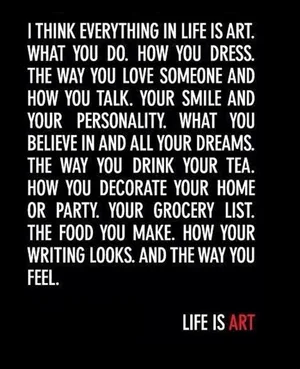
Heather Thomas reflects on this year’s Partners for a New Economy Conference.
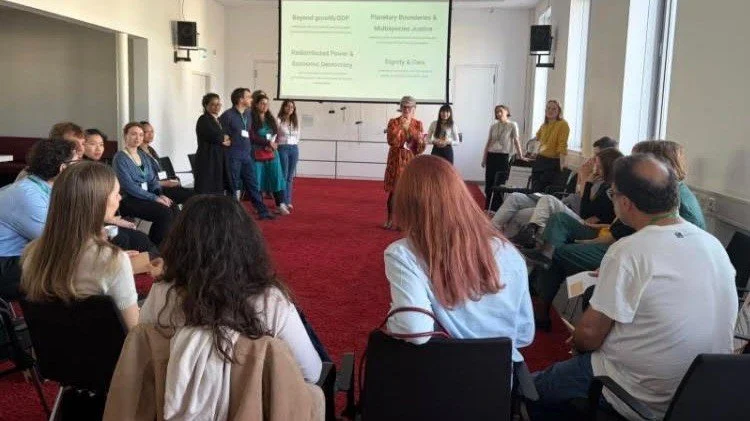
With the New Economy Leadership Academy at 'Turning Together', Bonn, Germany, October 2026
Over the past month, that phrase has been on repeat in my mind. Nowhere more readily than at the annual Partners for a New Economy Conference. This October’s gathering, Turning Together, was held at the Bundeskunsthalle (the people’s art museum) in Bonn, Germany.
The second I walked through the door, I encountered delegates I have had the privilege of befriending during this year’s New Economy Leadership Academy. Our first inclination in one another’s presence was not to hug or kiss (which we did do, eventually) but to smile so broadly our faces could barely contain the warm laugh-giggles of delight of being together. This was not merely a meeting of minds. It was a gathering of hearts and souls for whom being together feels like home.
Who are these people? They don’t start a conversation by telling you the job they hold or the skill for which they are employed. They start by showing you who they are.
Joyful. Courageous. Tenacious. Loving. Vibrant. Curious. Creative. Vulnerable. Worried. Resilient. Honest. Care-full. Gracious. Generous. Flawed. Humane. People who are not committed to mere systems change, but to creating an entirely new way for humans to organise ourselves so that all of life can thrive.
More than 200 of us came from across the world: community organisers, educators, communicators, activists, artists, policy makers, academics, impact researchers, financial analysts, and funders. Those are the varied things that we do. Who we are is something else: people who have chosen to see the invisible structures that surround us, that occupy space in our minds, that limit what is possible for all of life on Earth.
Some say the economy is broken. We see that it is doing exactly what it was built to do. Which is why we are committed to building a new one.
Cool. So, what on earth do icebergs have to do with it?

An iceberg and the Titanic courtesy of National Geographic. See how much more depth the iceberg has than the ship?
When I talk about an iceberg, I’m drawing on a model often attributed to Donella Meadows, systems thinker, Dartmouth professor, and one of the clearest minds of the twentieth century on how systems form and how they can change.
Above the waterline, you experience a system as events. A tariff battle. Being made redundant due to AI efficiencies. A Central Bank decision on interest rates. These are the things we react to and debate.
Grab your scuba gear (and a thermal wetsuit) because we’re going deeper.
Just below the surface: patterns and trends. The qualitative and quantitative data that have been building over time. Outsourcing of manufacturing. Inflated AI valuations. A persistent lack of consumer confidence. These patterns shape the decisions that produce the events we live.
Deeper still: systems. The structures we’ve built that enable these patterns to emerge. A GDP measure that treats growth as the only indicator of economic health. A household budget logic that makes austerity feel inevitable rather than chosen.
And at the very tip of the iceberg (20,000 leagues under the sea) lies culture. The values, attitudes, mindsets, and beliefs that shape our language and make certain behaviours feel normal, or otherwise. This is the hardest stuff to excavate, because it sounds like facts. There isn’t enough for everyone. People are inherently competitive. Profit above all. Growth is the goal. The ideas that have shaped how we see and how we experience the world.
See the problem…and see the opportunity? If we shift the culture at the tip of the iceberg, we build something that leads to very different events. A very different experience of life.
Little icebergs everywhere sank the Titanic.
The everywhere part matters. There is no one big solution. There is no one iceberg! What we need is to go 20,000 leagues under the sea and build plans and power everywhere, in every sphere of influence we have, from the football pitch to the board room, from the PTA to the team meeting. Those are all the communities within communities (or the icebergs within icebergs) in which we live. The more we create cultures and systems that enable us to live our values in each of them, the more resolute they become and the more we feel their absence when we’re in a community not built to practice same culture.
And I find it hopeful not to forget what we know about tipping points: we don’t need 100% of people to make massive change happen. Research by Damon Centola at the University of Pennsylvania suggests that when a committed minority reaches around 25% of a social group, a tipping point occurs and the new norm begins to overturn the old one. Change catalysts come first. They gather others. And something new starts to emerge, not because everyone agreed, but because enough people were living it.
Was culture being discussed in Bonn?
Yup. Eric Beinhocker, Executive Director of the Institute for New Economic Thinking at Oxford’s Martin School, used his keynote to break down the paradigm stack upon which neoliberal economic theory has been built, essentially an excavation of the tip of the iceberg. The moral values. The scientific underpinnings. The normative implications that show up as policy, law, and market design. The full package we'll need to build a new economic paradigm fuelled by cooperation. Same components, different purpose, different cultural drivers, different outcomes.
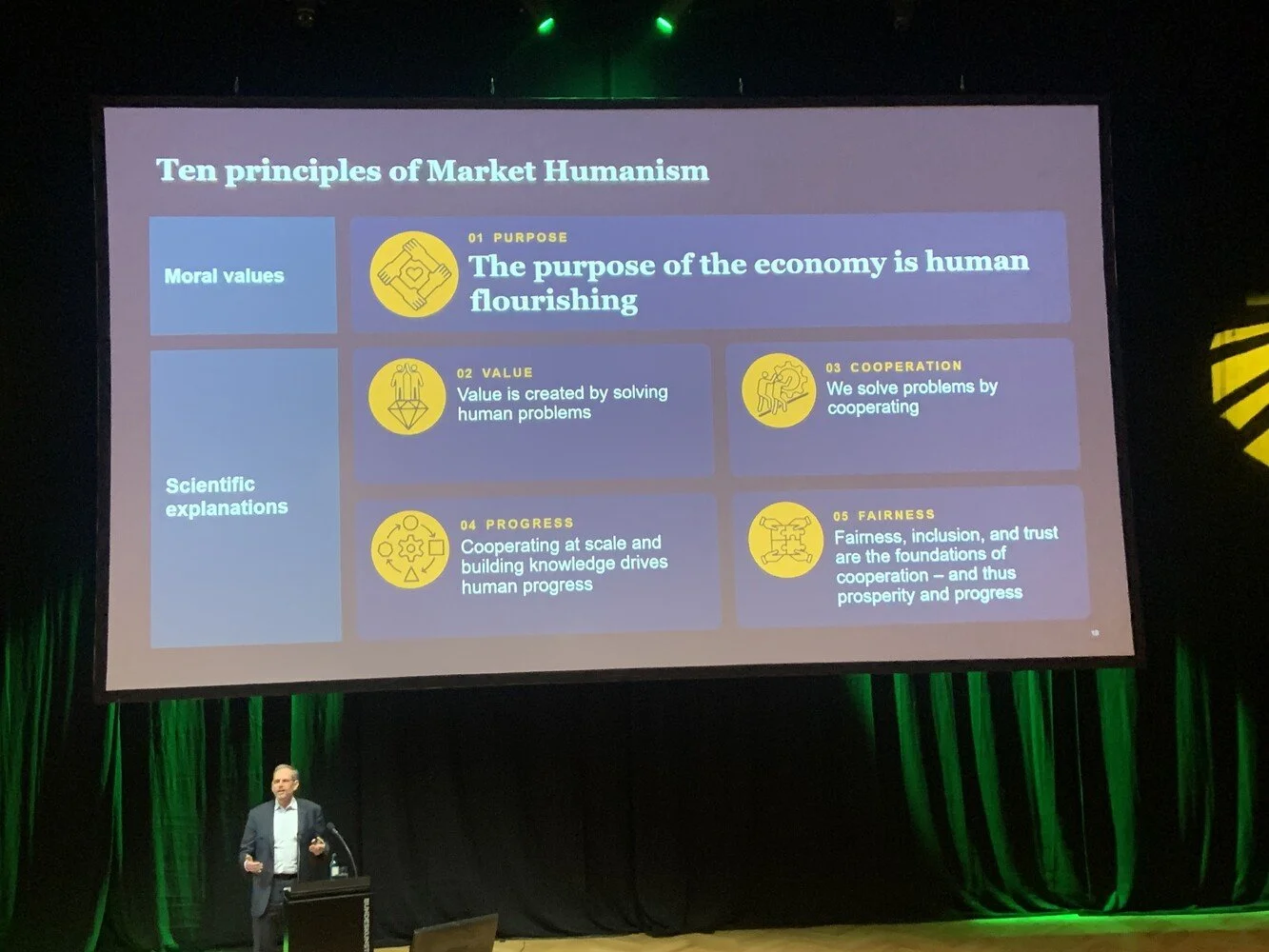
Eric Beinhocker explaining Market Humanism, a full paradigm package alternative to neo-liberalism.
People were named economic cultural foundations differently, but they seemed to point in a similar direction: a way of organising ourselves that enables dignity, choice, and shared belonging rather than competition and extraction.
I had the privilege of co-facilitating a session with New Economy Leadership Academy alumni across cohorts where we gathered to see where we were aligned in this audacious movement, to sit with tensions, and explore what it means to be an emerging leader in a radically progressive space. It was a wonderful collaboration with Mai Tanyamai Colamorea, Yu-Shan Chiu, Cindy Wegner, Carol Tan, India Burgess, Ishrat Jahan, and many others. What emerged in that room was evidence that people are increasingly drawn to a purpose that is about a culture of dignity, choice, and economic democracy.
Sounds great. How do we make this practical?
1. Economy starts with community.
I work with a definition I learned from Charles Vogl: a community is a group of people actively engaged in supporting one another’s wellbeing. And an economy is how we organise ourselves to live in community.
I often hear people talk about community happening organically. What I think they mean is that if you put people together, community will just magically appear. We have all lived on this planet long enough to know that is not true. Community emerges when the conditions are nurtured for it to do so. That takes intention.
What does nurturing those conditions look like? In a recent piece of co-creation work that I lead, a group described the conditions for nurturing legacy as flexibility, visibility, credibility, and consistency. Flexibility to meet people where they are. Visibility so people can find each other. Credibility built through showing up and following through. And consistency itself, turning up, again and again, until you become part of the fabric. These are the qualities through which trust builds over time and relationships become real.
I recently spoke with one New Economy Leader who had set an intention to visit a local independent bakery multiple times a week. Their reasons started with relationships in a new neighbourhood, to understand, befriend, become part of the fabric of the community. Yes, also to support an independent local business. But the intent was community first and the buying of pastries was the economic exchange that made it possible.
What does that look like in your world?
2. Go deeper than debating language.
Language debates abound. Care economy? Wellbeing economy? Neighbourhood economy? These are not idle arguments, words matter.
But let's try not to get stuck debating words. Language is a tool of culture, not the culture itself. When a debate starts to feel circular, pause and look beneath. What values, attitudes, rituals, and beliefs does each word represent? Where is there alignment? Where is the tension and what is it protecting?
If you can name what’s underneath, you can often find a bridge. And sometimes you discover that two groups are using different words to describe the same direction. When that happens, you can let the language go. Don’t get caught and stuck in the word debate when the movement is what matters.
3. Map the power you already have.
In a session on workers in the informal economy led by Laura Alfers of WIEGO and Naila Kabeer of LSE, something clicked for me about power that I am already using in my work one week later!
Power can feel like an overwhelming word. Especially if we only think of it turning up as money and authority-over. But what if instead of mapping powerful and not powerful, we mapped the ecosystem of power?
What types does your organisation, your community, or your coalition already hold?
Moral power
Symbolic power
Cultural power
Cooperative power
Relational power
Financial power
Legal power
What’s missing from that list? What type of power can you most readily work to develop? How would your strategy differ if you built it around a step-by-step plan to develop and share power across all these dimensions?
4. Check yourself when you start worrying about scale.
The grassroots versus top-down framing kept surfacing in Bonn, and it left me uncomfortable. I think because it began to feel linear, polar. And it doesn’t add up to how I understand change happens.
Ecosystems have lots of middles and zones. Different places where different things happen that impact the whole. It’s why I tend to think of how to build strategies that connect neighbourhoods and communities within communities.
Think of it as a jam sandwich. Two slices of bread (grassroots and institutional) with jam spread generously between them and smooshed together. Once you smoosh, you’re thinking like an ecosystem. The jam doesn’t stay separate. It gets absorbed into both.
Little icebergs everywhere means prioritising depth over reach, strong ties over broadcast, and wide bridges that let complex change travel. Shared experience that reinforces new behaviour until it becomes the new normal. The tipping point doesn’t require everyone. It requires enough people living it together.
Making it real.
One of the most poignant moments at conference was the offers and needs market exchange at which more than 200 people participated, facilitated by Donnie Maclurcan of the Post Growth Institute and Charmaine Blaize of Women of Colour Scotland. It did what it said on the tin. We sat in circles of six, for two hours, and people surfaced what they could offer others, had space to surface needs they were facing challenges meeting, and connections quickly formed. We tend to call this kind of thing trade or exchange. But in my opinion, what's happening is tip of the iceberg relationship-building. The economy has always been a relationship forging system. What types of relationships do we want to be in? What culture do we want to hold with and for one another?
My big takeaway from conference (and my year in the New Economy Leadership Academy) is that the work, whether you are in a community organising project, a cooperative, a think tank, a public institution, or a funder, is to bring a cultural strategy into everything you build. Bringing culture into our work be it public finance or monetary policy could deepen the impact of that work. Resist the temptation to go mechanistic as a start and race towards finding the leverage. Culture is the operating system that will yield different results. If we skip it and expect different outcomes….well, there’s a famous quote attributed to Einstein that got bantered about at conference too.
I help people figure out how to weave intentional cooperative culture building into their work through Together Culture’s Groundwork programme. If this resonated, I would love to talk.
Everyone in the new economy movement is stood at the tip of an iceberg already. How do we harness that power to sink the Titanic? And more importantly, make space for a new ship to sail.