
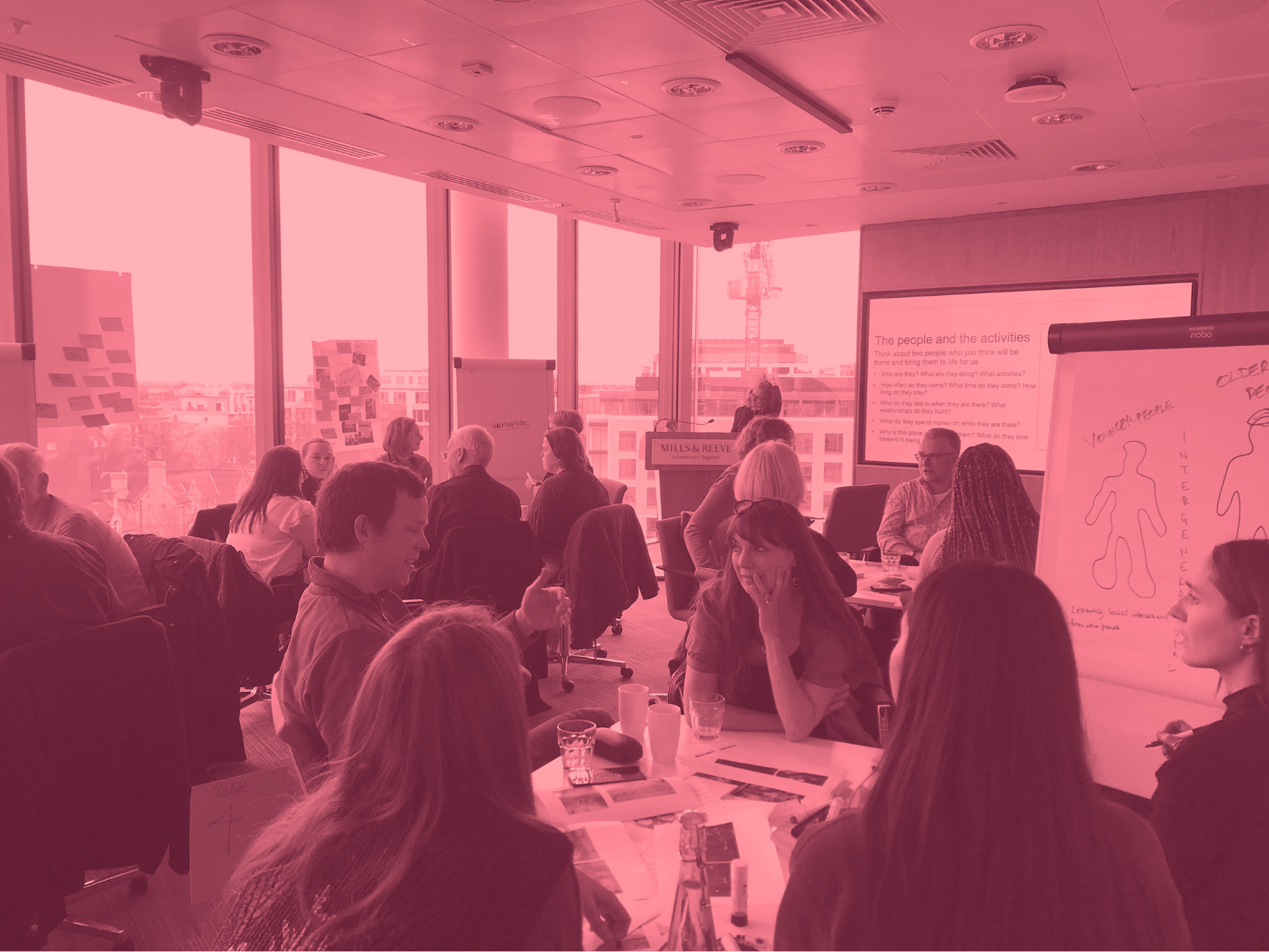
A workshop for people working towards a different economy in their organisation, their community, or their neighbourhood.
See what’s possible with
Less is More
Why reaching fewer people might be
your most powerful strategy.
In 110 minutes, identify exactly who to gather to create the critical mass necessary for real, compounding change.
£37 · 110 minutes · Live online · Max 10 participants
Are you finding your way into building the different economy you can already picture? Navigating an organisation whose culture keeps returning to what it knows? Or just beginning to see that the economy is a human creation, and therefore can be remade?
Wherever you are in that journey, you've probably already felt it: the pressure to prove your work in numbers that don't quite fit it.
Funders want reach.
Colleagues measure success by how many people attended.
And underneath all of it, you have a sense that those metrics are measuring the wrong thing entirely.
You're not confused about what needs to change. You just need the evidence, the framework, and a room full of people who already understand the territory, to be able to say clearly why going deeper is the stronger path.
Whether you're still finding your footing in the regenerative economy movement, pushing for change from inside a system that resists it, or somewhere in between, building the kind of change that lasts starts here.
The evidence for going deeper.
Here's what the research actually shows: transformative cultural change, the kind that shifts what people believe about the economy and their own power within it, doesn't spread by reaching as many people as possible.
It travels through strong ties. Trusted relationships. Shared experience. People who are actively doing something new together, and who bring others in because of what they've seen and felt, not because of a message they received.
The US Civil Rights Movement of the 1960s made major legislative breakthroughs with with as little as 3.5% of the population actively participating at its peak.

Preston City Council redirected £75m of anchor institution spend without legislation and without a majority.
Ireland legalised same-sex marriage by popular referendum driven by approximately 22% actively campaigning.
Research on tipping points consistently finds that around 25% of a group, deeply committed and well-connected, is often enough to shift what everyone considers normal.
You don't need everyone. You need the right people, connected in the right ways, doing something real together.
What happens in the session
Less is More is a 110-minute live workshop that explores how to gather to reach a tipping point.
The Stories We Carry About Scale
Using Mentimeter, we surface what you and the room actually believe about how change spreads, in real time and without judgement. The results almost always surprise people. That surprise is where the work begins.
Tipping Points in the Wild
We work through real examples: Preston City Council, the Civil Rights movement, the referendum on same-sex marriage in Ireland, Spain’s Mondragon Corporation. Not as inspiration but as evidence: what actually made them work, and what that reveals about your own context.
The Science of How Change Actually Travels
We explore why transformative change travels through trusted relationships and shared experience rather than reach alone, and what that means practically for how you spend your time and energy. You leave with the evidence to explain this clearly to your team, community or collaborators.
Start Shaping Your Tipping Point Strategy
Using Miro, you map where your strongest relationships already are, who to gather in your specific context, what activities create the depth of connection that changes behaviour over time, and how to recognise when new norms are beginning to take hold.

This is for you if
You've read widely, you resonate deeply with community wealth building and regenerative economics, and you're ready to know what applying it actually feels like in practice
You're inside a council, university, or non-profit organisation that keeps pulling back from where you can see it needs to go, and you need the language and the evidence to bring colleagues with you
You're earlier in this work, you've started to see through the surface of how the economy actually operates, and you want a grounded starting point rather than another reading list
You're being asked to demonstrate impact through reach and numbers, and something about those metrics keeps feeling like the wrong measure of the right work
Before
You measure success by reach, attendance, and numbers, because that's the language everyone around you seems to speak.
You sense that going deeper is the right instinct but you don't yet have the evidence to back it up or the words to explain it to anyone who asks.
You have a general sense of who needs to be involved but no clear map of who to gather first, or why.
After
You measure success by the depth of the relationships in your committed core, and you have the science to explain clearly why that matters more.
You know where to focus your energy and you can see the change beginning to compound.
You leave having started to shape your tipping point strategy for your specific context, wherever you are in the work.
I’m Heather Thomas, the founder of Together Culture, and I'm so glad you're here.
Whether you found us because something in your work keeps stalling despite your best efforts, or because you can see exactly what needs to change and can't yet find the lever, I want you to know that I understand where you are.

I've spent my career sitting at the intersection of culture and change. I studied history. Worked in cultural strategy, social change and tech for good. I got my MBA in Copenhagen to better understand how the system worked to try and change it. I studied the Nordic Food Movement, opened a cultural hub and wrote a book about how people could connect to their true nature as a part of nature through food culture.
And then one morning, five years ago, I woke up and discovered that my neighbourhood in Cambridge had been sold to a multinational private equity firm thousands of miles away. I lay there scrolling through the news thinking: how on earth did we get here? And what does it actually take to change things?
What I kept returning to was this: real change isn't about fighting for a seat at the table that already exists. To paraphrase the iconic feminist Gloria Steinem, it's about building a new table, with entirely different rules.
That's when Together Culture was born; in Cambridge, one of the most socially unequal cities in the UK. We built methods to get to the root of building a more inclusive and ecological economy: our culture. After all, it's our attitudes, values, and behaviours that limit or expand our reality. If we want complex change to happen, we have no choice but to change our culture.
That’s exciting, because from that point of view you don't have to be a policy wonk to be an economist. Policy wonks don't shape our culture; we all do, each and every day.
And culture, that I know. I'm a social scientist working on my PhD to better understand how culture change at the neighbourhood scale creates the tipping points that make a regenerative economy real.
We’re all economists now. I trust you are ready to stop carrying the resistance alone and start working with the power you already have. So you can build the skills, the tools, and the relationships to make an economy that enables all of life to thrive.
What shifts when you stop trying to reach everyone
-
You redefine what success looks like
You start measuring the work by the depth of the conversations happening and the behaviour change emerging from them, whether that's inside an institution, a community, or an initiative you're just beginning to shape
-
You can name the strategy clearly
You go into a conversation with a funder, a manager, or a colleague and have the language to explain clearly why your strategy is focused by design, and why that's a strength.
-
You see exactly where to put your energy
You look at your map and see where your strongest relationships already are, where you've been spreading energy too thin, and exactly where to redirect. Wherever you are in the work, that clarity changes things.
£37. 110 minutes.
Who to Gather to Reach a Tipping Point
Plus the behavioural science to explain to anyone who asks why focused, relational strategy is the most efficient path to lasting change.
Less is More.
Wednesday 16 September
12 - 1.50pm BST
£37 plus VAT.
Solidarity pricing available — if cost is a barrier, email us first: heather@togetherculture.com