How We Live Together is the Economy We Create
Heather Thomas, Together Culture’s founder, reflects on what we mean when we talk about the economy.
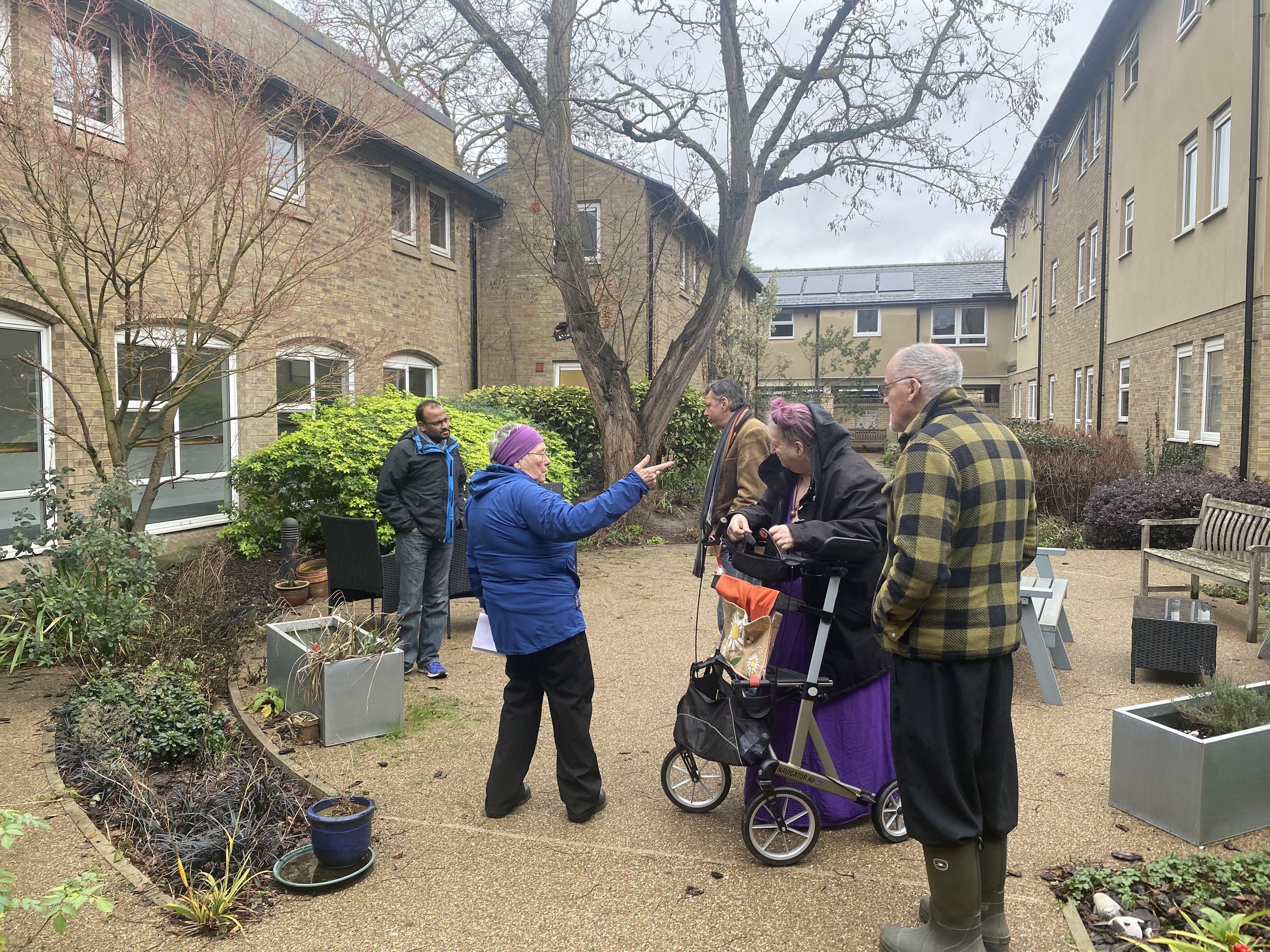
The Kite Permaculture Garden at Brandon Court in Cambridge, where we’re developing and testing our methods for building neighbourhood economies.
Relearning how to live, work, and decide together
One of the bright spots of my 2026 so far has been joining the second Regenerative Economy Lab cohort run by the seemingly indefatigable Katy Shields. (her energy is contagious) I’ve been learning, experimenting, and connecting with regenerative changemakers who are focused on building a non‑extractive economy.
What does that actually mean? And what does Sesame Street have to do with it?
Keep reading.
At its heart, regenerative culture is about creating an economy that helps us live in community. If a community is a group of people who actively support one another’s wellbeing (and the rest of life upon which we depend), then the economy is how we organise ourselves to make that support possible.
Rethinking the Goal of the Economy
The goal of a regenerative economy is not endless growth for a few. Growth still happens, but as part of a living cycle. Money becomes a public good, used to meet the full range of human needs identified by economist Manfred Max‑Neef as — subsistence, protection, affection, understanding, participation, leisure, creation, identity, and freedom.
Freedom here doesn’t mean Friedmanesque “free markets” that enabled neo-liberalism to spread. It means power with and power to — not power over. It’s the freedom to collaborate, to contribute to the collective, and to explore what it means to thrive together rather than compete for survival. Community grounds us and that connection gives us a tethered freedom to explore with security. Failure is not a crisis if you aren't going to lose your home OR your friends. Failure in that context is an experiment and a learning opportunity.
These 'power to' and 'power with' ideas were imprinted upon my brain in Kindergarten. Those are the values that were instilled in me. That's the connection to Sesame Street. My mental model says this IS possible and desirable. I bet your childhood self thinks the same. I bet you teach your children the same. If economists who've won Nobel Prizes are modelling HOW we can do this, why on earth do we still resist organising ourselves so we can all thrive in life?
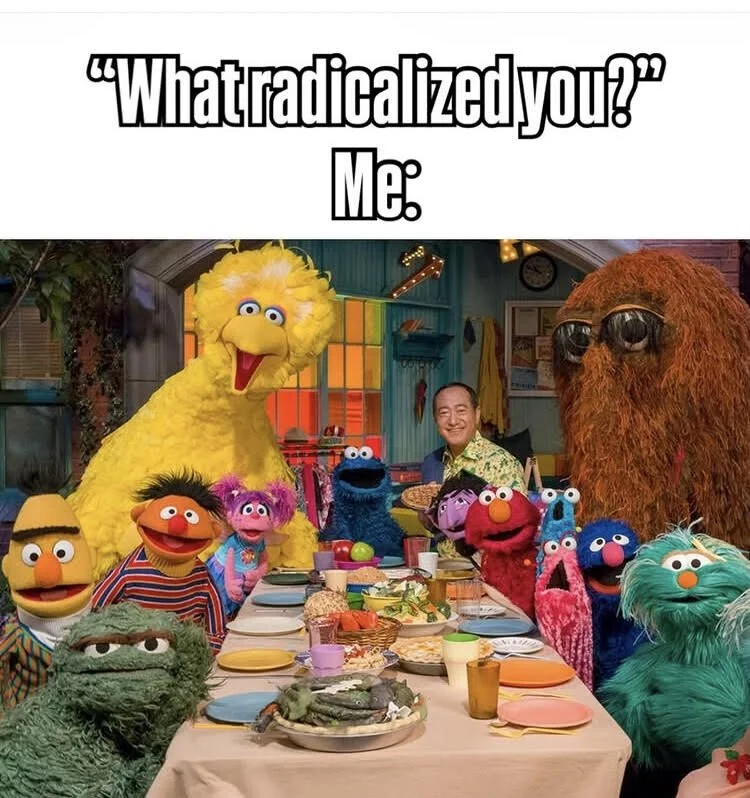
Using economic models from Neef, Ostrom, Meadows we can interpret this image as an economy set up to share prosperity and allow humans (and muppets) to be fully human. Image credit to Sesame Street and Jim Henson Studios
Learning from Living Models
Not everyone IS resisting. Some people are setting up new ways of living. Not stepping out of society, but taking on the meaty work of building new communities with their own micro economies and equitable finance systems.
I’ve been meeting extraordinary people who are already putting these ideas into practice. One is Christian Loy, co‑founder of Krötenwanderung (“Frog Walk”), an Austria‑based initiative that redirects financing toward commons-oriented projects like cooperative housing and land trusts.
Christian helped found Cambium, a cooperative housing initiative where money functions as a tool for solidarity, not private profit. Residents pay contributions based on their means, and those funds support “Universal Basic Services” shared by all.
If you’re picturing one giant shared house, let me burst that bubble. Cambium occupies a renovated former military base — now a network of private homes and communal spaces. From the outside, it looks like a normal housing development. But instead of profits flowing to developers and banks, money circulates within the community.
Decisions about Cambium’s multimillion‑euro community fund are made collectively. It’s a sophisticated, scalable system — so much so that Austria’s government is now adapting regulations to support more than 18 similar commons-based projects. That process is not straightforward, but it's happening - that's the important part.
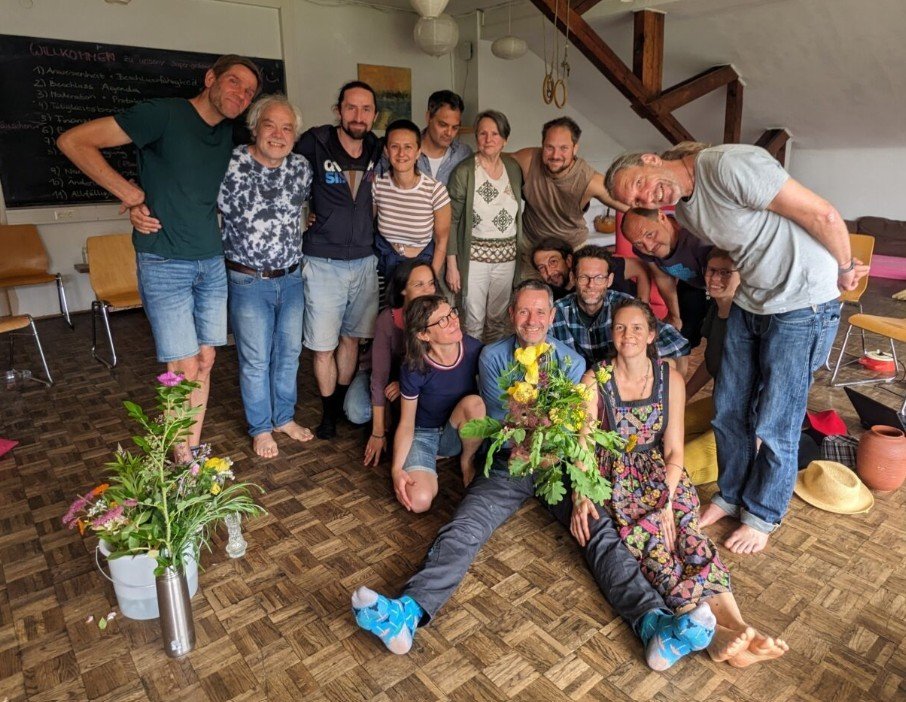
Here are some of the real, live human beings living at Cambium in Austria. Figuring things out, changing how they think and act, and deeply rooting a new type of community and economy. Proving these ideas are not just childhood fictions.
Shifting Our Mental Models
When I asked Christian how his life had changed since moving to Cambium, he said simply:
“I can’t imagine going back to Vienna and living a life where I don’t make decisions about where I live with other people.”
Participatory governance and micro‑economies demand both new ways of thinking and new skills. At Cambium, they’ve even hosted improv‑theatre nights to help people unpack their assumptions about money, banks, and value — and to practise talking about them openly with loved ones who aren't quite there yet.
This is deep behavioural work: exploring where our mental models come from, discerning what’s true, and unlearning what we’ve absorbed from living in an extractive and unequal system.
It also means developing practical collective skills:
Seeing from other perspectives
Listening deeply
Navigating disagreement to create something new
Making participatory decisions beyond binary choices
Behaviour Shapes the Economy
We call it behavioural economics for a reason — our current economy is designed to shape certain behaviours: competition, extraction, isolation.
If we want to shift that model, we need to learn and embed new behaviours — ones that make an equitable and ecological life possible.
One of the most exciting outcomes, for me, is trust. When we practise these new ways of living together, we learn to trust ourselves, one another, and the institutions we create.
Living Together: Practice Makes Possible
There’s more I could share as I weave these insights into my doctoral research on behaviour change — how it spreads, and how it acts as the foundational lever for shaping a new economy. But that’s a story for another blog.
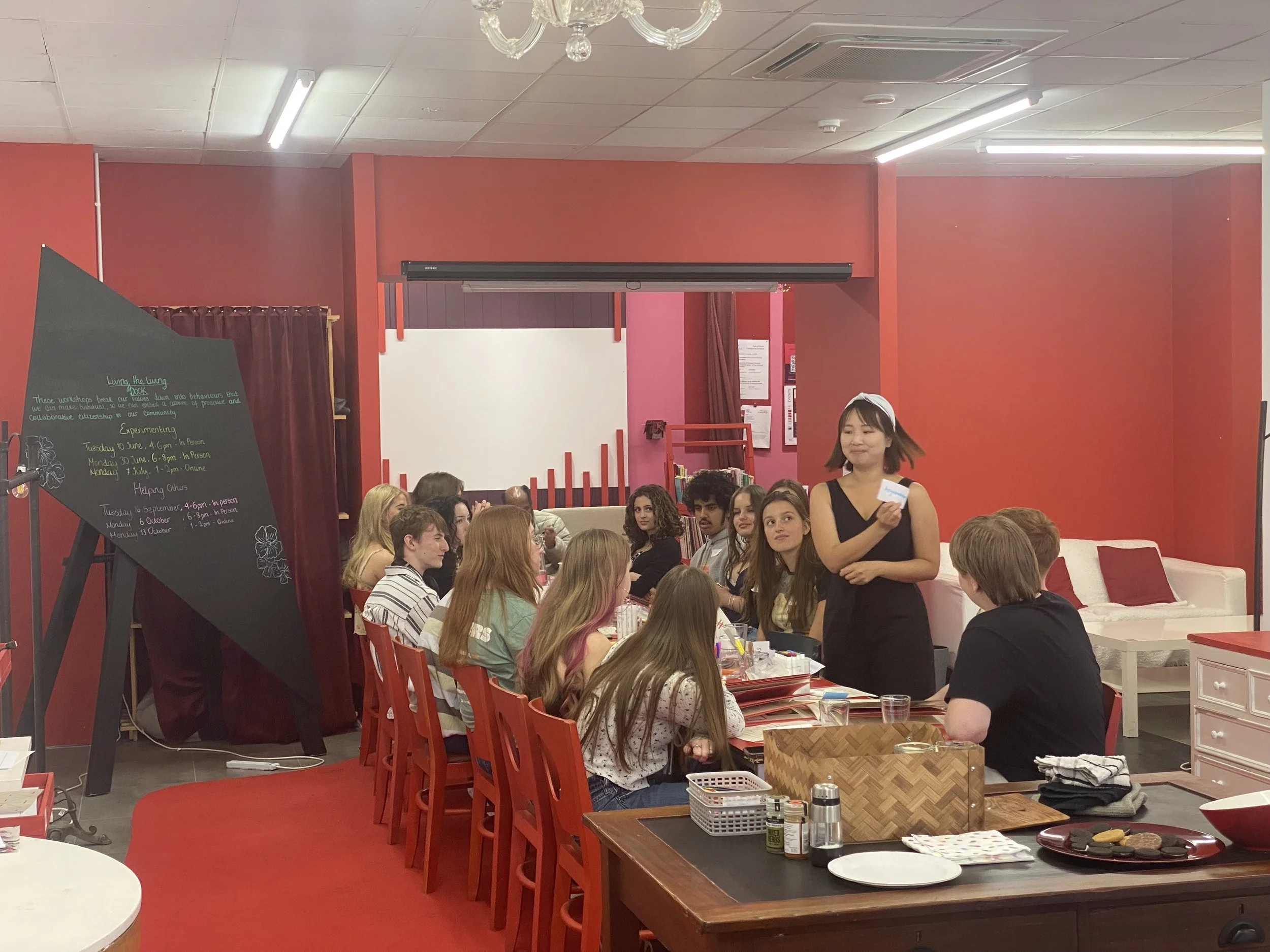
One of Together Culture’s previous Living Together workshops
For now, I’m convinced that small groups of people practising new ways of being have always been the seeds of transformation.
That’s why I’m so looking forward to Together Culture’s Living Together Retreat on Saturday 14 March.
We’ll have fun (yes, including “Bog Fashion,” exploring Nordic style circa the year 900!). But beyond the play, we’ll be learning the practical skills of collaboration and participatory decision‑making — exactly the capacities that re‑root economy in community.
This year, we'll be applying those skills in two group projects:
The Kite Heritage Festival – unearthing and celebrating the contribution of working‑class culture to Cambridge innovation
The Kite Permaculture Garden at Brandon Court - our multi-generational project where we’re learning from nature about how to think like an ecosystem
It’s not too late to join us — and I truly hope you will.
👉 Sign up for the Living Together Retreat here.
The economy isn’t out there somewhere - it’s in how we live together. Every conversation, every shared decision, every act of trust is part of the redesign.
You definitely hold the power to help transform the human world.